Given the major environmental challenges facing the textile industry, the issue of raw materials has never been more critical. Among these, wool holds a special place.
As a natural, renewable, recyclable fibre that is biodegradable at the end of its life, it represents a credible alternative to synthetic fibres derived from fossil fuels. Although it currently accounts for only a tiny fraction of the global textile fibre market – less than 1% of production volumes – wool however has one one major advantage: it is already one of the most recycled fibres relative to its market share.
In this context, recycled wool is emerging as a key driver of the transition towards a more circular economy.
Wool: a fibre with great potential for the circular economy
Globally, around 6 to 7% of the wool produced comes from recycling. This figure, modest at first glance, actually reveals a remarkable achievement: relative to its total volume, wool is one of the most recycled textile fibres, far ahead of recycled cotton and, proportionally speaking, on a par with recycled polyester.
This trend can be attributed to the fibre’s intrinsic qualities: mechanical strength, elasticity and durability, which enable it to withstand multiple life cycles.
Recycling wool helps to mitigate the initial environmental impact associated with sheep farming, the use of agricultural land and the resources required to produce this naturally high-performance fibre.
From used textiles to a new raw material
Recycled wool comes from two main sources: end-of-life textiles from consumers (post-consumer) and industrial offcuts or waste generated during manufacturing (pre-consumer).
Collected via sorting centres, take-back schemes or directly from manufacturers, these materials are diverted from landfill or incineration and instead recycled.
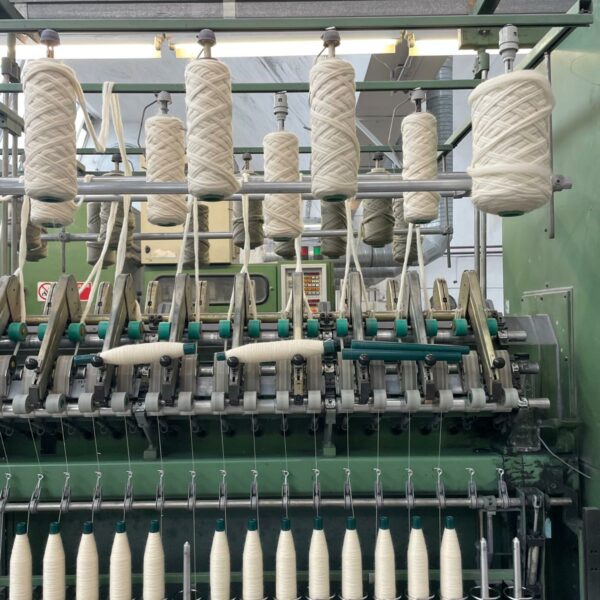
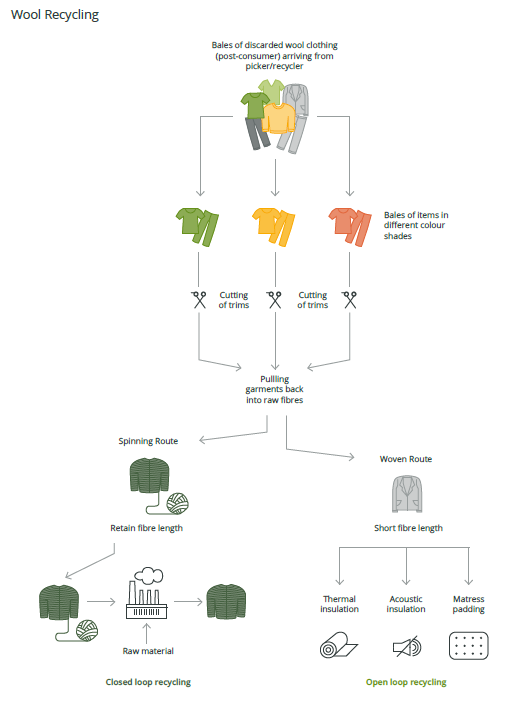
Wool recycling relies primarily on a mechanical process that has been perfected over many years: rigorous sorting by fibre type and colour, removal of accessories, defibration, followed by carding and spinning.
This demanding expertise makes it possible to breathe new life into existing fibres, often by blending them with virgin wool to ensure a level of quality, durability and comfort suited to textile-to-textile recycling and the demands of ready-to-wear and high-end textiles.
(schema IWTO)
A strategic material for the textiles of tomorrow
Recycled wool has a wide range of applications: fabrics for coats and jackets, knitwear and accessories, as well as technical uses such as insulation and padding.
For a wool company such as Segard Masurel, this represents a tangible means of promoting circularity, enabling it to offer wool and yarns with a lower carbon footprint, thereby meeting the growing expectations of brands and consumers regarding eco-design and traceability.
Compared with other textile fibres, wool stands out for its significant advantages when it comes to recycling. When carried out correctly, its mechanical recycling relies on tried-and-tested processes that are energy-efficient.
Conversely, the chemical recycling of synthetic fibres requires intensive processes – solvents, high temperatures and depolymerisation – which consume more energy and resources, thereby increasing their environmental footprint and slowing their widespread adoption.
Finally, the intrinsic added value of recycled wool facilitates the development of dedicated, sustainable supply chains, whereas many low-cost textiles remain difficult to recover.
Wool recycling is not a magic bullet.
It should be seen as a complementary pillar of the circular economy, alongside eco-design, reducing the volume of textiles, and the production of virgin wool from responsible and regenerative farming practices. Now more than ever, sheep are part of the solution, and wool, in all its forms, is establishing itself as a fibre of the future for a more sustainable textile industry.